ONOZU — LOS ANGELES
Jacaranda in Late Spring
Jacaranda flowers gather colour above warm pavements, then mark the curb with a brief violet season.
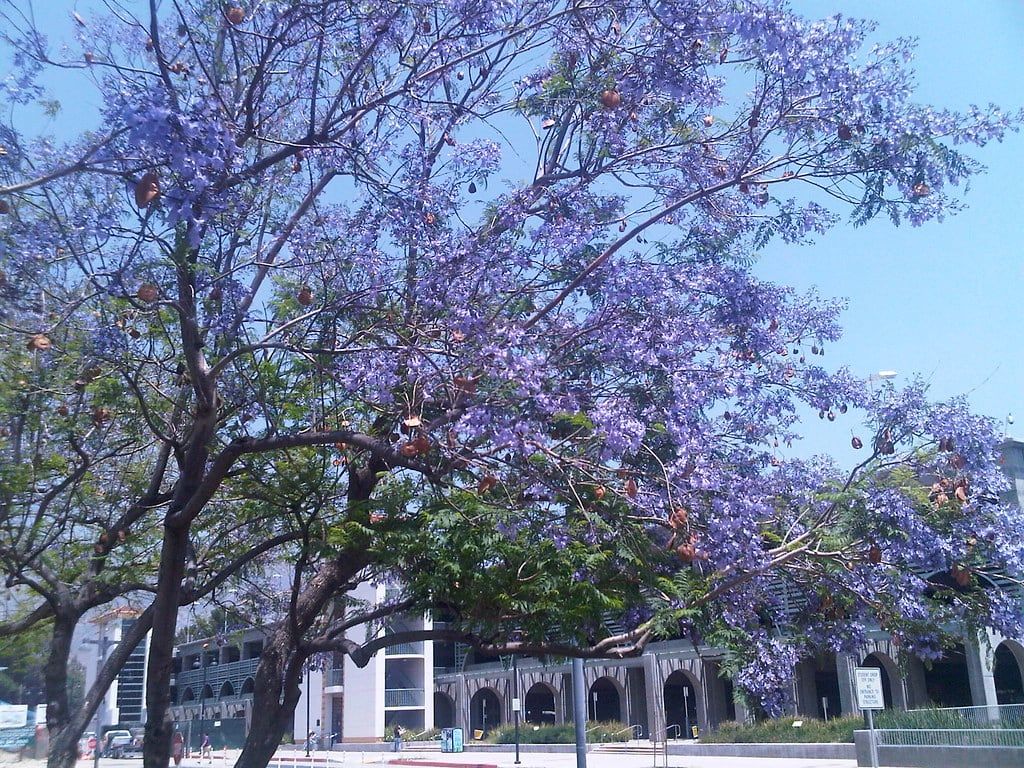
Jacaranda by feculent_fugue. Source, licensed under CC BY 2.0. Auto-oriented, resized, metadata stripped, and recompressed; responsive AVIF/WebP derivatives are generated at build time.
For much of the year, a jacaranda can blend into the varied canopy of a Los Angeles street. Its branching form is open, its leaves fine enough to let light through, and its shade moves easily over walls and parked cars. In late spring the same tree becomes unmistakable. Violet flowers collect along the outer branches until the crown appears to hold a second, cooler sky.
The colour changes with the hour. Under morning cloud it is deep and even, closer to ink than purple. When direct sun reaches the flowers, the upper clusters turn pale at their edges while shaded blooms remain saturated. Against stucco, asphalt, and dry soil, this cool colour can seem unexpectedly bright without becoming harsh.
Above and below
The flowering is visible in two places at once. Overhead, clusters join across neighbouring branches. Below, fallen trumpets make loose patterns along gutters and paths. Some remain intact for a short time, their curved forms resting on the pavement. Others are pressed into darker marks by feet, bicycle tyres, or the slow movement of a parked car.
These fallen flowers give the season a daily rhythm. A pavement swept in the afternoon is violet again by morning. Wind gathers petals against the base of a wall, while water from a garden hose carries a few toward the drain. The tree is not simply in bloom; it is continually releasing the bloom into the street.
Jacarandas are not native to Southern California, yet they have become part of the planted urban landscape. Their presence is therefore different from the chaparral on a dry slope or the annual grasses after rain. They belong to an arrangement of gardens, sidewalks, utility lines, and regular care. The flowers make that arrangement visible: branches are trimmed around cables, roots lift sections of concrete, and shade falls across boundaries between public verge and private yard.
The brief violet interval
As the season advances, green becomes dominant again. New leaves thicken, flower clusters become sparse, and the carpet at the curb fades. A few blossoms often remain high in the crown after the strongest display has passed.
The value of this short interval is not rarity. It is repetition with variation. The same street changes colour each year, but cloud, pruning, heat, and the timing of each tree alter the result. Late spring can be read in those differences: one block already green, another still violet, and a final scatter of petals holding colour in the shade.