ONOZU — LOS ANGELES
Long Shadows in Griffith Park
Late light crosses Griffith Park at a low angle, separating ridges, dry plants and footpaths into clear layers.
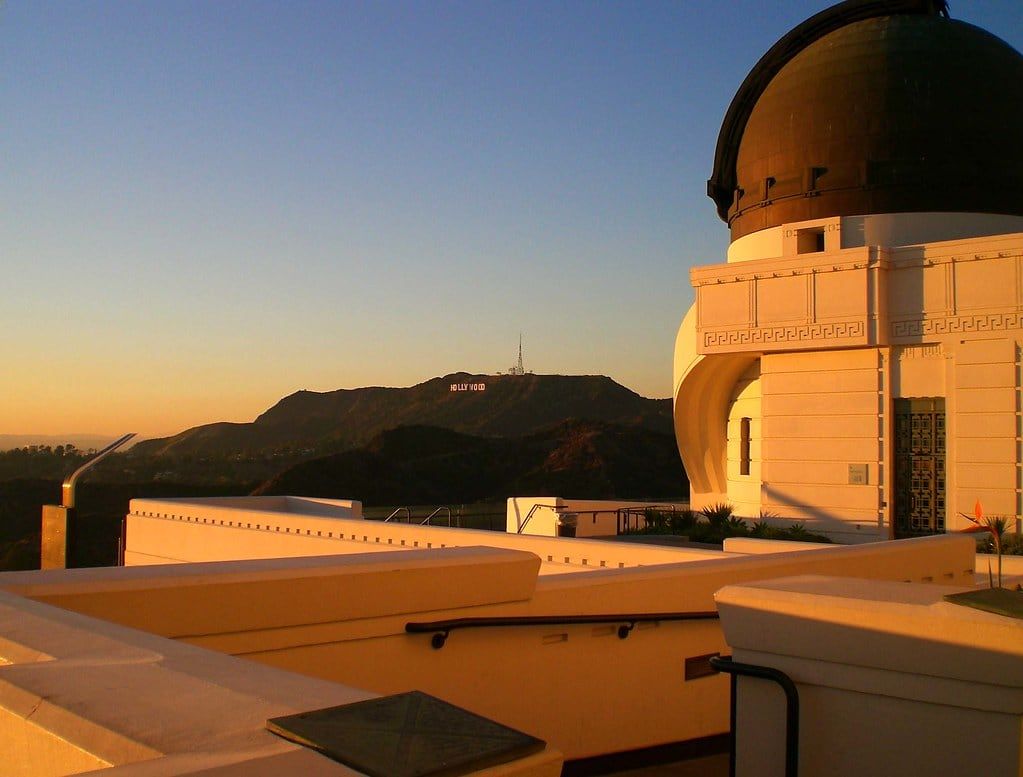
Griffith Park Observatory & Hollywood Sign by Marcy Reiford. Source, licensed under CC BY 2.0. Auto-oriented, resized, metadata stripped, and recompressed; responsive AVIF/WebP derivatives are generated at build time.
Late in the day, Griffith Park becomes a study in direction. The sun is low enough for every upright stem, fence post, and rock to cast a line across the ground. Paths that looked flat at midday gain edges. Small rises interrupt the light, and shallow hollows fill with shadow before the larger slopes darken.
The season has left the open ground dry. Grasses are pale, seed heads brittle, and exposed soil ranges from warm brown to grey. These restrained colours hold the afternoon light well. Illuminated stems appear almost white, while the shaded side of the same patch becomes cool and muted. A few evergreen shrubs keep deeper colour and anchor the changing surface.
Ridges in sequence
From a bend in a path, nearby ridges overlap with more distant ones. The closest slope shows individual plants and stones. Beyond it, detail gives way to broad areas of light and shade. The farthest ridge is reduced to a dark outline against the sky. This sequence lasts only while the sun remains above the western horizon.
Movement is easy to notice in such angled light. A bird passing over the path is accompanied by a quick shadow. Dust lifted by a shoe becomes visible for a moment and then disappears. Leaves turn between bright and dark as a breeze moves through a sheltered group of trees.
The city remains present around the park, although it may be heard more clearly than seen. Traffic forms a distant continuous sound. Closer noises—a runner’s steps, a gate closing, dry leaves shifting—arrive separately. The broad view and the near sounds do not cancel each other; together they describe a large urban landscape with pockets of concentrated attention.
The quick end of daylight
As the sun lowers, shadows join. A line from one shrub reaches the dark area beneath another. Warm colour leaves the path first where the ridge blocks the west, while higher ground continues to hold a narrow band of light. The transition can be measured in minutes.
After sunset, the distinctions soften again. Dry grass, soil, and chaparral settle into similar tones, and the skyline becomes the clearest remaining edge. The long shadows have vanished, but they have briefly made the shape of the park legible—each slope, plant, and ordinary path described by the light it interrupted.