ONOZU — LOS ANGELES
Marine Layer Before Sunrise
A low ceiling of coastal cloud softens the city before the first direct light reaches the streets.
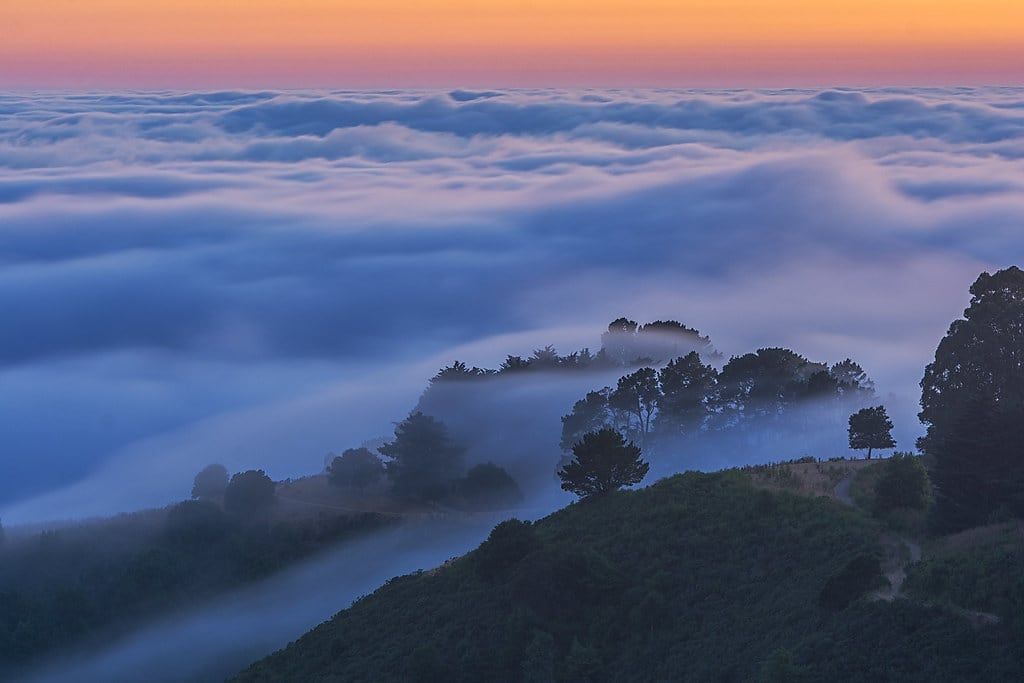
Embraced by the Fog by Jaykhuang. Source, licensed under CC BY 2.0. Auto-oriented, resized, metadata stripped, and recompressed; responsive AVIF/WebP derivatives are generated at build time.
Before sunrise, the marine layer changes the scale of Los Angeles. Distant ridges disappear first, followed by the upper floors of buildings and the taller palms. Streetlights remain visible in the grey air, but their circles are small and diffuse. Without a clear horizon, the city feels less expansive. Attention settles on the nearest slope, the sound of a passing car, and moisture gathered along the edge of a leaf.
The cloud is not dramatic. It arrives as a low, continuous ceiling from the coast and rests over the basin while the ground is still cool. Its lower edge is uneven. A hill may appear for a minute and then close again behind pale vapour. In places where the street rises, the fog seems close enough to touch; lower down, it becomes a quiet brightness with no obvious source.
Light held in cloud
The first daylight does not form a bright line in the east. Instead, the whole sky gains colour slowly. Charcoal becomes blue-grey, then a muted silver. Painted walls and dry soil take on nearly the same value, while darker plants hold their outlines. The absence of direct sun reveals small differences that noon usually flattens: the cool side of a retaining wall, a web stretched between railings, and drops along the narrow tips of grass.
Sound also seems nearer under the cloud. Birds call from roofs that cannot be seen clearly. Tyres make a brief hiss on damp pavement. Farther traffic becomes a steady, low layer beneath these sharper sounds. The city is already moving, but the weather keeps its edges soft.
A temporary coast
The marine layer rarely stays unchanged. As the ground warms, openings begin above the hills or along a bright western edge. Blue appears in small sections before it occupies the sky. Shadows return gradually: first beneath parked cars, then under trees, and finally across whole streets.
By late morning, the cloud may look as though it was never present. The pavement dries, distances reopen, and the familiar hard light returns. A few wet leaves in shade are often the last evidence. The change is ordinary and seasonal, yet it gives the early hours a distinct shape—a short interval when Los Angeles is measured not by distance, but by what remains visible nearby.